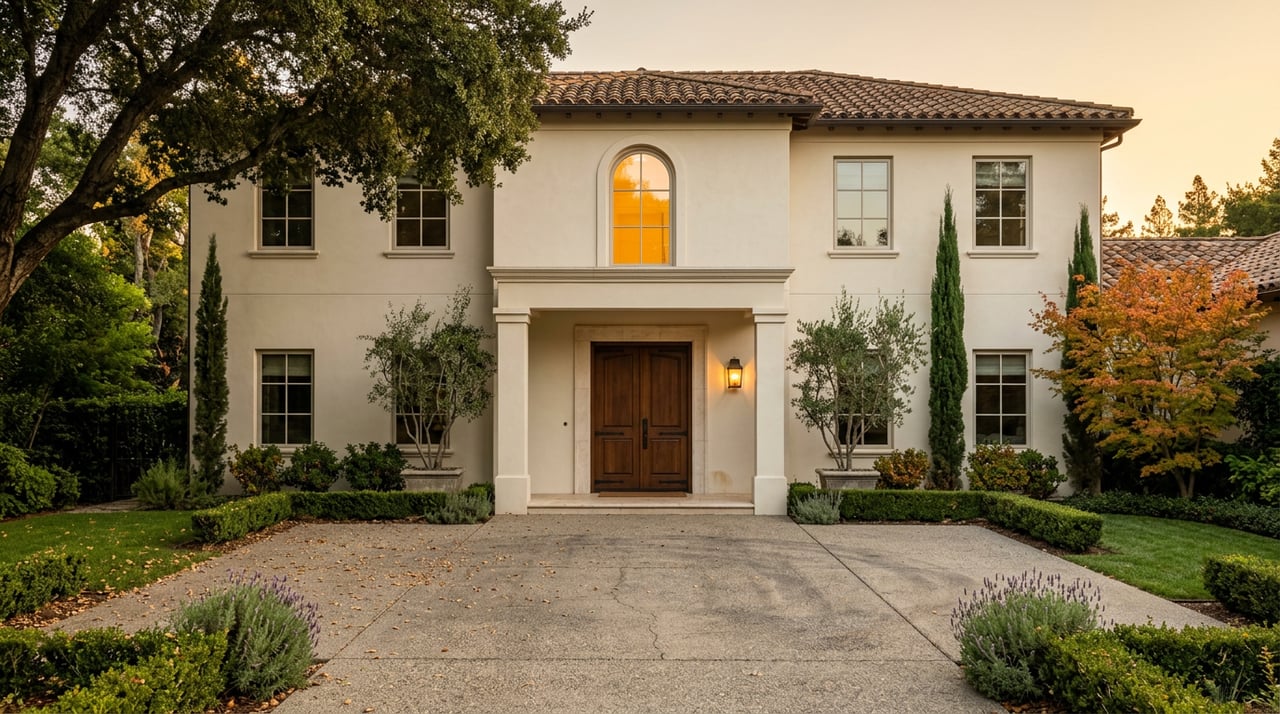
If you have been tracking Pleasanton listings from outside the market, the headline number probably told you the same thing it told everyone else this summer: prices are softening. The median sale price for detached single-family homes came in at $1,570,000 in July 2026, down 6.52 percent from July 2025. Sales volume for the year is running more than 20 percent behind last year's pace. Inventory ticked down slightly to 83 active listings by the end of July, but homes still aren't routinely fetching over asking the way they were twelve months ago.
Then you look at Ruby Hill, the gated golf community on Pleasanton's eastern edge, and the average sale price there is up 27 percent year over year, sitting near $4 million, with homes going pending in about 14 days.
Both of those numbers are accurate. They are also describing two different markets wearing the same city name. If you are comparing Pleasanton against other Tri-Valley or East Bay neighborhoods, the distinction matters more than either stat on its own.
The Citywide Number Is Genuinely Cooling
Start with what the broader data actually shows, because it is a real shift, not noise. July marked the third straight month where the $3 million-plus segment fell further behind its 2025 sales pace, a gap that has now widened for three consecutive months. Citywide, 40 homes sold in July, essentially flat with June's 38 but 31 percent below the 58 that sold in July 2025. Look at year-to-date totals and the gap has been growing every month: 14.9 percent behind in May, 20.7 percent in June, 22.7 percent in July.
July also brought a smaller but telling shift: it was the first month all year where sellers didn't average full asking price on closed sales. They still closed near it, average sale-to-list ratio stayed close to 98 percent, but the streak of full-price averages broke. By classic measures this is still technically a seller's market. Months of supply sat at 2.0, well under the 5 to 6 months that usually signals balance. Homes are still selling in under a month on average. But the direction of travel is unmistakable, and the busiest price band all year has been $1.3 million to $1.7 million, which accounted for 37.7 percent of all 2026 year-to-date sales. That is the tier absorbing most of the buyer activity, and it is also the tier feeling the most competition from a slightly larger pool of listings than a year ago.
None of that describes what is happening on the other side of the golf course wall.
Ruby Hill Is Playing a Different Game
Ruby Hill was built starting in 1992 by Signature Properties, a private, guard-gated community of roughly 850 residential lots wrapped around an 18-hole golf course designed by Jack Nicklaus. It sits within the Livermore Valley wine region, close to Shadow Cliffs Lake, and it has always operated as its own submarket inside Pleasanton rather than an extension of it.
That separation shows up in the 2026 numbers. While the citywide $3 million-plus segment is losing ground on volume, Ruby Hill's average sale price is up 27 percent year over year to roughly $4.02 million, and homes there are selling in about 14 days on average, faster than the citywide pace. At the same time, those Ruby Hill sales are still closing modestly below list price on average, around 2 percent under. That detail is the key to reconciling the two numbers. Ruby Hill isn't seeing a bidding war. It is seeing a shift in which homes are actually changing hands. When a neighborhood has a small number of annual transactions and a wide range of home sizes, from roughly 2,000 to 10,000 square feet plus a smaller number of larger custom estates on acre-plus lots, a handful of larger or more heavily upgraded homes closing in a given quarter can move the average sharply without any change in how buyers are bidding against each other.
In other words: the citywide median is telling you that typical Pleasanton buyers have more room to negotiate than they did a year ago. Ruby Hill's average is telling you that the small number of buyers shopping at the very top of the market this year happened to be buying bigger, pricier homes than last year's buyers did. Those are two separate stories, and a seller pricing a $2.5 million home based on Ruby Hill's trendline, or a buyer assuming citywide softness extends into the gated community, would be working from the wrong data.
What Your Money Actually Buys, By Tier
| Tier | Typical 2026 range | What's actually driving it |
|---|---|---|
| Mid-market tracts (Vintage Hills, Val Vista, Birdland, Mohr Park) | Roughly $1.3M to $1.7M | The busiest segment in the city, 37.7% of 2026 YTD sales. Competition here is steadiest because these tracts sit inside Pleasanton Unified boundaries and offer the most inventory relative to demand. |
| Broader citywide single-family | $1.5M to $1.9M depending on the month | Cooling on a year-over-year basis, with more room to negotiate than a year ago outside the core mid-market band. |
| Ruby Hill custom estates | Roughly $3.7M to $4M+ on average | Low transaction volume, wide range of home sizes, and a buyer pool thin enough that a few large closings can swing the average without reflecting a broader repricing. |
If you are comparing Pleasanton to a neighboring city and only have the citywide median in hand, you are most likely comparing against the $1.3M to $1.7M tier, since that is where most of the volume sits. Ruby Hill is a different conversation entirely, with its own pace, its own buyer pool, and its own homeowners association running the gate.
The School District Detail That Surprises Buyers
Here is a friction point worth knowing before you write an offer rather than after. Most of Ruby Hill sits within the Pleasanton Unified School District, which is a large part of the community's appeal. But the far eastern section of the neighborhood is technically located within the Livermore school district's boundary. An agreement between the two districts allows all school-age children living in Ruby Hill to attend Pleasanton schools regardless of which district their specific lot falls under.
That arrangement has held for years, but it is not something a buyer should assume from an address alone. If school assignment is a deciding factor in your offer, confirm it directly with both districts rather than relying on the general reputation of the neighborhood. It is a small detail with real consequences if it gets overlooked during a fast-moving transaction.
Reading a Listing Like Someone Who Tracks This Market
Two mechanical details matter more in a market like this one than they did a year ago.
First, days on market can be misleading. A relisted property often resets its market-time clock, so a listing showing 20 days on market may actually have been available, under a different listing number, for considerably longer. Ask directly rather than taking the headline number at face value.
Second, watch what percentage of active listings have already taken a price reduction. A meaningful share of Pleasanton's active inventory this summer had already been repriced at least once, which tells you that initial list prices across the city have been running ahead of where the market is willing to transact. Homes that sell fastest, inside two weeks, are still commanding close to full asking price on average. Homes that sit longer are the ones absorbing the reductions. Pricing precisely at the outset, rather than testing a number and adjusting later, matters more in this environment than it did a year ago, particularly above $3 million where buyer depth has thinned.
Quick Answers
Is Pleasanton a buyer's or seller's market right now? By the numbers, still technically a seller's market. Months of supply sat at 2.0 in July 2026, well under the 5 to 6 months that typically signals balance, and homes are still selling in under a month on average. But the margin has narrowed, and July was the first month this year sellers didn't average full asking price.
Why did Ruby Hill's average price rise while the citywide median fell? Ruby Hill's low transaction volume means a small number of larger or more expensive closings can move the average significantly without reflecting broader bidding pressure. Homes there are still selling modestly below list price on average, which points to a shift in which homes sold rather than a surge in competitive offers.
Do all Ruby Hill homes attend Pleasanton schools? Most of the neighborhood sits within Pleasanton Unified. A portion of the eastern section falls within Livermore's district boundary, but an inter-district agreement allows Ruby Hill's school-age residents to attend Pleasanton schools. Buyers should still confirm current arrangements directly rather than assuming based on the neighborhood's general reputation.
Working Through the Details
Numbers like these are useful for framing a decision, but they don't replace a conversation about your specific price point, timeline, and property. If you're weighing a move within Pleasanton or comparing it against another Tri-Valley community, Joe Sabeh can walk through what the current data means for your particular situation, tier by tier, before you write an offer or set a list price.