The Best family and the Starr family each built a grotto to Our Lady of Lourdes and another to the Sacred Heart, on facing sides of the same garden. The garden's walking tour reads the duplicates as a sign that the shrines mattered to both households. They also show how the Gardens at Palmdale were made. The five acres off Mission Boulevard were two private gardens divided by a paved road, with the Best garden north of it and the Starr garden south. On a late-November afternoon, the side you start from shapes the walk. Most of the fall color the tour points out is on the Starr side.
Two Estates on One Old Mission Parcel
The Garden Conservancy calls the gardens one of the last remaining fragments of the Mission San Jose land grant. It also says the palms that gave the garden its name came after the Franciscan missionaries' olives, fruit trees and vines. According to the Library of Congress's Historic American Landscapes Survey report, Elias Lyman Beard established the Palmdale estate in the late 1850s. Juan Gallegos acquired land there in 1881. His winery went up in 1884–85 and was incorporated as the Palmdale Wine Company in 1894. The 1906 earthquake destroyed it.
The two houses that still stand were built in the late 1920s for the Best and Starr families. C. L. Best formed the Caterpillar Tractor Company. Between 1927 and 1948 the two families lined the ponds with cement, added two grotto areas and planted many exotic specimens. Many of the lawns and shrubs were dug up for the 1939 Golden Gate International Exposition in San Francisco. The Sisters of the Holy Family bought the houses and about 12 landscaped acres on September 1, 1948. In 2019 the Sisters conveyed the gardens to the nonprofit Gardens at Palmdale, Inc., which placed them under a conservation easement and dedicated them on May 10 of that year. Both houses and their backyards are private and are not part of the public garden.
The volunteers wrote a walking tour for that 2019 dedication. It covers about half a mile in roughly 30 minutes, and most of it is wheelchair-accessible. The tour numbers its stops and many of its trees. The walk below follows that order and its tree numbers.
The Best Side Starts at the Sundial
The tour starts at a sundial to the right of the Best House, behind a large tree. That tree is Monterey Cypress #101, about 75 feet tall and 22 feet across. The tour says it may have been planted by the Franciscan missionaries and may be more than 200 years old. A second large Monterey cypress once grew in the lawn area and no longer stands. A female ginkgo also grows near the cypress. Remember it, because its male partner is on the other side of the road.
The Sunken Garden comes next. It started as a fourth pond that overflowed every winter and flooded the Best home, until Mr. Best closed it off and planted it. Some rocks from its 1926 fountain are still partly buried in the ground. Coast redwood, silk oak, Norfolk Island pine, Western sycamore, California incense cedar, magnolias and palms surround it, and the tour lists trees from California, New Zealand, Australia and the eastern United States here. The young Norfolk Island pines have what the tour calls a distinctive "Christmas tree" outline, which fits the season.
Above the Sunken Garden are the Best family's Sacred Heart grotto and its Lourdes grotto. Two faux-bois chairs and a basin face the Sacred Heart grotto. A faux-bois bridge near the Lourdes grotto crosses Mission Creek. Faux bois is concrete shaped to look like wood. The tour lists a barbecue, bridges and chairs made this way around the grounds, and it says nobody yet knows which artisans made them.
The Road Between Them Was a Racetrack
The paved road that splits the two gardens was Juan Gallegos's racetrack. It started at the Mission Boulevard entrance and ended at his winery in Irvington, where Washington Boulevard meets Osgood Road today. It was said to be exactly a furlong but actually runs almost two miles. The tour notes that Olive Avenue from Starr Street down to Washington Boulevard still follows the route to the winery. In the families' time, guests could take canoes out on the cemented ponds. On the North Pond, a faux-bois bridge and placed rocks now mark the spot where water once drained out.
The Starr Side Has the Fall Color
Most of the color the tour mentions for this time of year is south of the road. The Heart Garden is first. According to the tour, Mr. Starr made it for his wife, Hazel, and it was once a small lake linked to the Southern Pond. The tour says its four maples "have quite a show of color" in autumn. Guadalupe fan palms line the driveway beside it, near incense cedars, a Lombardy poplar, a coast redwood and an Idaho locust. A gardener named Yoshi grew the Japanese maples around the grounds from seed in the 1950s.
The Southern Pond's fountains are built from locally quarried stone. Mission Creek feeds the ponds, and on an 1868 map the creek's water powered Laumeister's Mill. After the last bridge and a giant sequoia, a torii gate opens into the Sacred Garden, which some records call the Japanese Garden. Mrs. Starr had it built in the 1930s as a small Japanese stroll garden. Some of the plants set in the ground in the summer of 1936 are still there and have grown large, including Japanese maples, a magnolia, a cherry tree and Hinoki cypresses. The ponds lost their water supply in the 1989 earthquake. On the dry island you can still pick out the head, legs and tail of a classic tortoise island.
The garden has five shrine-grottoes, to St. Jude, St. Joseph, Our Lady of Lourdes, St. Anthony of Padua and the Sacred Heart. According to the tour, Hazel Starr promised Our Lady of Lourdes a grotto if her husband Oscar found work somewhere better suited to them than Illinois, and that is how the couple came to the Bay Area. The St. Joseph and St. Jude grottoes went in just before the property changed hands. Mission San José takes its name from St. Joseph.
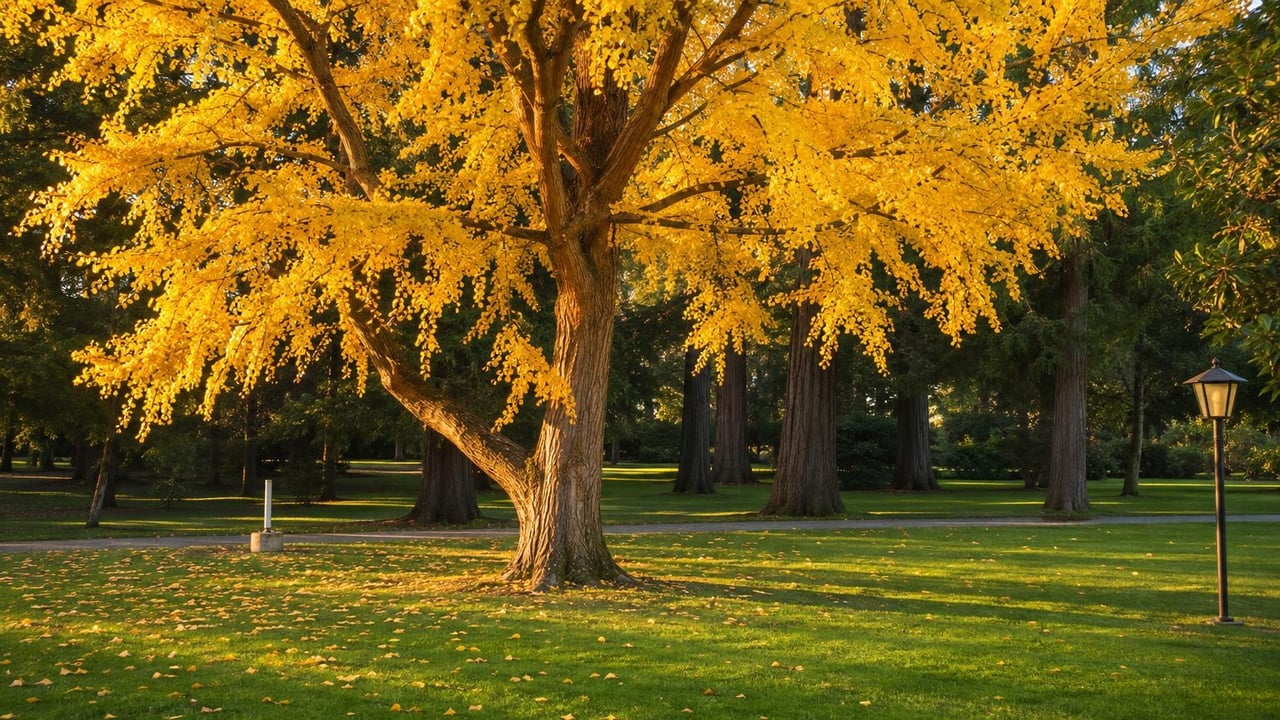
Next on the tour is the Peace Pole, which went up on December 31, 1995, at 5:00 a.m. The Southern Magnolia, #329, comes after it, and then the male ginkgo, tree #328, planted in 1938. The tour says ginkgo leaves "make a carpet of golden yellow" in fall, so this is the time of year to look for it. The walk ends at the Wishing Well, which is a capped septic tank with olives, Canary Island date palms and a Dawn redwood around it.
Getting There Before Sunset
The park is open from sunrise to sunset and closed from sunset to sunrise. The visitor guidelines ask visitors not to enter after dark. Afternoons are short in late November, so anyone planning a walk over the Thanksgiving weekend should get there with time to spare. Children under 12 must be with an adult, and bikes, skateboards and scooters are not allowed. Dogs must be leashed and owners must clean up after them. Picnics, grilling and smoking are not permitted, and visitors are asked to stay out of the water.
According to the Gardens at Palmdale website, the address is 43202 Calle Dolorosa. Parking on Avenida Palmdale is limited, with a few ADA spaces, and there is no parking inside the park. The site suggests parking on Washington Boulevard and walking down historic Mission Boulevard, or parking on Starr Street at Mission Boulevard. The garden has no restrooms, food, drinks or trash cans. Its website points visitors to the restaurants along Washington and Mission Boulevards. One of these is Mission Pizza & Pub at 1572 Washington Boulevard.
The garden is also part of the walk through the Mission San Jose village. On September 13, 2026, it was a Doors Open California site, and its guided tours started from the steps of the Old Mission San José church at 43266 Mission Blvd., as shown on the California Preservation Foundation schedule. Tri-City Voice listed it with Fremont's other Doors Open historic sites that weekend. On an ordinary afternoon you can follow the same route on your own. Park on Washington, walk past the Mission, and do the half-mile loop through both families' gardens before sunset.
Places like the Palmdale cypress and the 1938 ginkgo are part of what a Mission San Jose address comes with. If you're starting to think about what your own home in the district is worth, Joseph Sabeh Group is glad to talk it through, and you can request a home valuation whenever you're ready.